
Alternating Current (AC) vs Direct Current (DC)
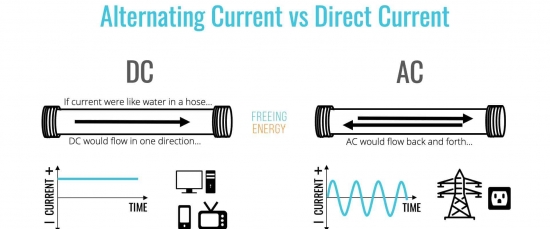
Alternating Current (AC) vs Direct Current (DC) Where did the Australian rock band AC/DC get their name from? Why, Alternating Current and Direct Current, of course! Both AC and DC describe types of current flow in a circuit. In direct current (DC), the electric charge (current) only flows in one direction. Electric charge in alternating current (AC), on the other hand, changes direction periodically.
The voltage in AC circuits also periodically reverses because the current changes direction. Most of the digital electronics that you build will use DC. However, it is important to understand some AC concepts. Most homes are wired for AC, so if you plan to connect your Tardis music box project to an outlet, you will need to convert AC to DC.
AC also has some useful properties, such as being able to convert voltage levels with a single component (a transformer), which is why AC was chosen as the primary means to transmit electricity over long distances. Alternating Current (AC) Alternating current describes the flow of charge that changes direction periodically. As a result, the voltage level also reverses along with the current. AC is used to deliver power to houses, office buildings, etc.
Generating AC AC can be produced using a device called an alternator. This device is a special type of electrical generator designed to produce alternating current. A loop of wire is spun inside of a magnetic field, which induces a current along the wire. The rotation of the wire can come from any number of means: a wind turbine, a steam turbine, flowing water, and so on. Because the wire spins and enters a different magnetic polarity periodically, the voltage and current alternates on the wire. Waveforms AC can come in a number of forms, as long as the voltage and current are alternating. If we hook up an oscilloscope to a circuit with AC and plot its voltage over time, we might see a number of different waveforms. The most common type of AC is the sine wave. The AC in most homes and offices have an oscillating voltage that produces a sine wave. Applications Home and office outlets are almost always AC.
This is because generating and transporting AC across long distances is relatively easy. At high voltages (over 110kV), less energy is lost in electrical power transmission. Higher voltages mean lower currents, and lower currents mean less heat generated in the power line due to resistance. AC can be converted to and from high voltages easily using transformers. AC is also capable of powering electric motors. Motors and generators are the exact same device, but motors convert electrical energy into mechanical energy (if the shaft on a motor is spun, a voltage is generated at the terminals).
This is useful for many large appliances like dishwashers, refrigerators, and so on, which run on AC. Direct Current (DC) Direct current is a bit easier to understand than alternating current. Rather than oscillating back and forth, DC provides a constant voltage or current.
Generating DC DC can be generated in a number of ways:
An AC generator equipped with a device called a "commutator" can produce direct current
Use of a device called a "rectifier" that converts AC to DC • Batteries provide DC, which is generated from a chemical reaction inside of the battery Using our water analogy again, DC is similar to a tank of water with a hose at the end.
Goutam Education Academy
Blog ID : 28
If anyone feel the content of this post is not in community guidelines, It may be considered upsetting, offensive, or sensitive. then please help us to report this.
Report to admin